
7 Questions to Ask Before Choosing a Pilates Teacher Training Program
If you’re considering becoming a Pilates instructor, you’ll quickly discover that there are many teacher training programs available. Some are offered entirely online. Others take place over weekends or intensive weeks. Some focus only on the mat work, while others offer training one piece of equipment at a time.
With so many options, how do you know which program is right for you?
After more than 20 years of teaching Pilates and nearly a decade working within teacher training programs, I’ve watched students choose certification programs, complete their training, and grow into confident instructors. I’ve also seen how the quality of a teacher training program can shape that journey.
Whether your goal is to teach professionally, deepen your understanding of the method, or simply explore Pilates on a deeper level, here are seven important questions to ask before enrolling in any teacher training program.
1. Who Will Actually Mentor You?
Most programs provide manuals, videos, and coursework. Those resources are important, but they are only part of the learning process.
A better question is:
Who will help you when you begin teaching real people?
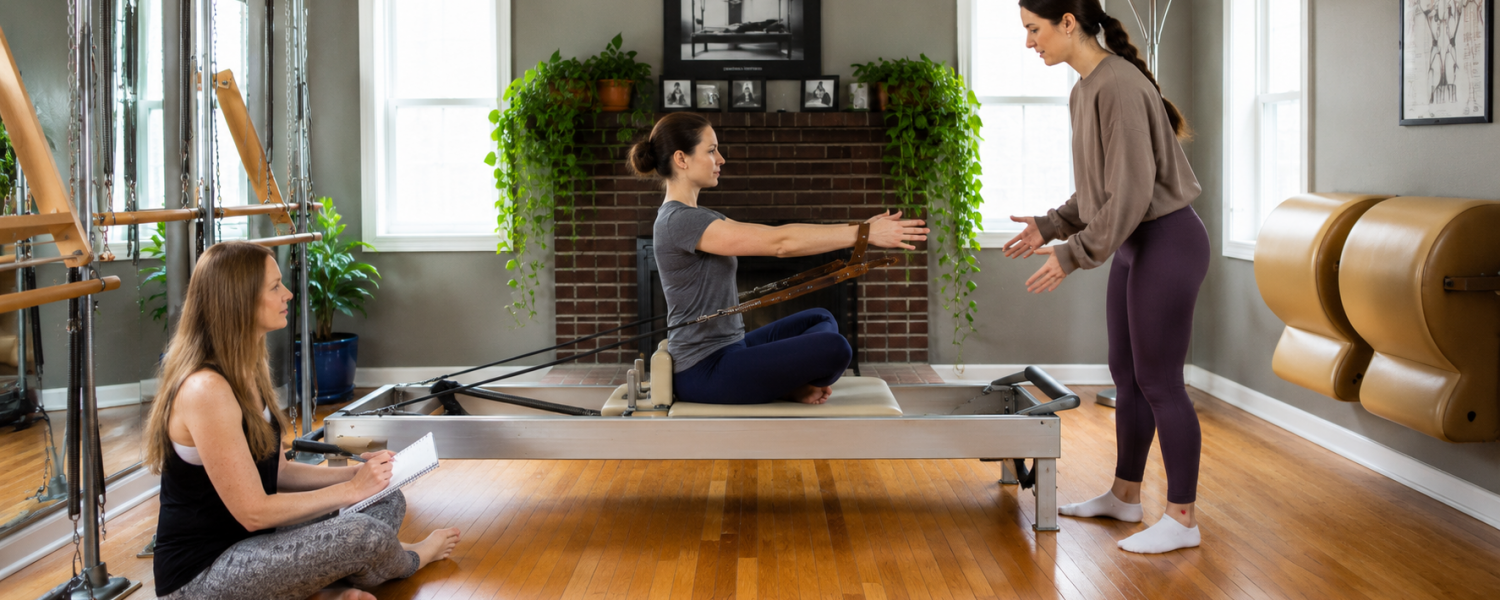
Teaching Pilates involves far more than memorizing exercises. You’ll encounter clients with injuries, movement restrictions, anxiety about exercise, and unique learning styles. Having access to experienced teachers who can answer questions, provide feedback, and help you navigate real-world situations can make a tremendous difference in your growth.
Look for a program that offers ongoing support, mentorship, and opportunities for discussion throughout your training.
2. Where Will You Complete Your Observation and Practice Hours?
Many certification programs require observation and practice teaching hours, but not all programs provide guidance on how to complete them.
Before enrolling, ask:
- Will I have access to a working studio?
- Will I be able to observe experienced instructors?
- Will I have opportunities to practice teaching?
- Is there equipment available outside of training weekends?
The more opportunities you have to observe and teach, the more confident you’ll feel when it’s time to work with clients independently.
3. How Much Individual Attention Will You Receive?
Pilates is a hands-on profession. While manuals, videos, and online coursework can be valuable learning tools, they cannot fully replace in-person instruction and practical experience.
Ask how much of the program takes place in a studio environment and how often you’ll have opportunities to observe movement, practice teaching, receive feedback, and work directly with equipment.
Learning to teach Pilates requires more than understanding the exercises. It requires developing the observational skills, communication abilities, and hands-on experience that come from working with real people in real time.
4. Does the Program Teach Exercises or Develop Teachers?
This may be the most important question of all.
A certification program can teach you the exercises. A great program develops you into a teacher.
Learning the Pilates exercises is only the beginning.
A strong teacher training program should help you learn:
- How to teach a first-time client
- How to recognize movement patterns
- How to modify for injuries and limitations
- How to progress clients safely
- How to communicate clearly and effectively
Knowing the exercises is valuable. Knowing how to teach them is what ultimately makes you an instructor.
5. What Happens After Certification?
Many students spend months completing a certification only to discover they still don’t feel confident teaching on their own.
Ask what support exists after the program ends.
Are there continuing education opportunities?
Can graduates continue to ask questions?
Is there a mentorship program available?
The best teachers never stop learning, and the strongest programs recognize that certification is the beginning of the journey, not the end.
6. Are You Learning Individual Pieces of Equipment or the Pilates System?
Many Pilates teacher training programs are organized by apparatus, offering separate certifications for the Reformer, Cadillac, Mat, and Chair.
At first glance, this can seem appealing. A student might be interested in learning the Reformer and assume that starting with a single apparatus is the most affordable option.
However, many students discover that by the time they complete separate certifications for multiple pieces of equipment, they have invested significantly more time and money than they would have in a comprehensive certification program.
As you’re comparing programs, make sure you understand the full commitment beyond the advertised tuition. Ask whether manuals, exams, required observation and practice hours, mentorship, and class requirements are included or paid separately. Having a clear picture of both the time and financial investment upfront can help you make an informed decision and avoid unexpected costs along the way.
More importantly, Pilates was designed as a system.
When students learn the method by level—Beginner, Intermediate, and Advanced—they begin to understand how the Mat, Reformer, Cadillac, Chairs, and Barrels work together. They learn how exercises build upon one another and how to safely progress clients through the method.
Understanding the system creates more confident teachers than learning individual pieces of equipment in isolation.
7. Will This Program Lead to National Certification?
Not all Pilates training programs are structured to prepare students for national certification.
If teaching professionally is one of your goals, ask:
- How many training hours will I complete?
- Does the program meet eligibility requirements for the National Pilates Certification Program (NPCP) exam?
- Will I be qualified to sit for a nationally recognized certification exam?
A clear pathway toward national certification helps ensure that your education is recognized beyond a single studio or training organization. It can also provide greater flexibility as you explore future teaching opportunities and career paths within the Pilates industry.
Even if you never plan to sit for the exam, knowing that your training meets nationally recognized standards provides valuable perspective when comparing programs.
The Right Program Is About More Than Certification
A Pilates teacher training program is an investment of time, energy, and money. While the curriculum and credentials are important, the learning environment matters just as much.
The strongest programs teach more than exercises. They teach a system, provide mentorship, create opportunities for practice, and offer a pathway toward professional certification.
Whether your goal is to teach professionally or simply deepen your understanding of the Classical Pilates method, asking the right questions can help you find a program that supports your long-term success.
If you’re considering Pilates teacher training and would like to learn more about our upcoming Mat Teacher Training or Comprehensive Certification Pathway, we’d be happy to answer your questions.